Warp Dynamics / Engineer's log / Supplemental
Engineer's log, supplementalStardate 2026.10.21

Checked against NASA

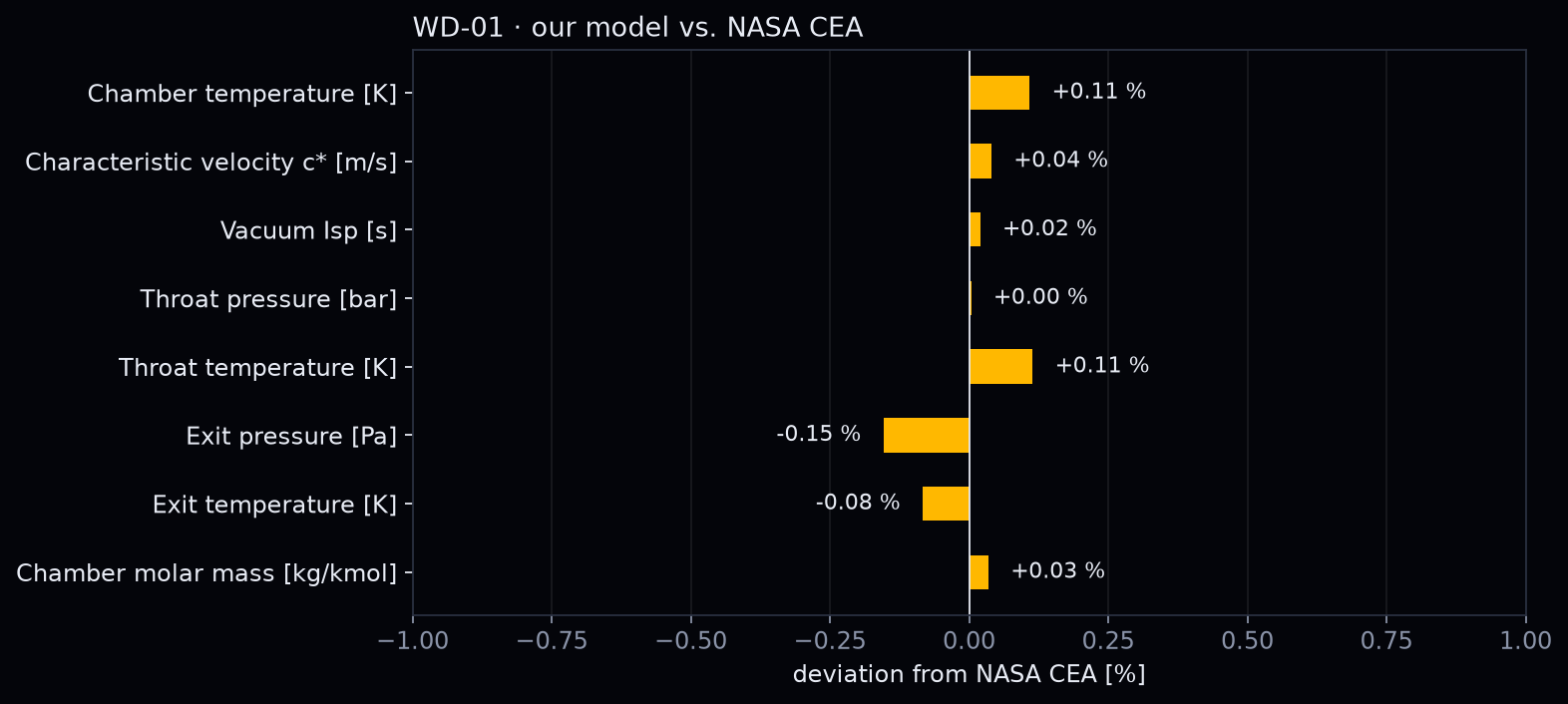
Our pipeline against NASA’s official CEA code for the same engine: chamber temperature, c* and vacuum Isp agree within 0.11 %. Test ladder level 1 passed.

Chamber temperature
+0.11 %
c*
+0.04 %
Vacuum Isp
+0.02 %
Largest deviation
0.15 %
Bar chart of deviations between Warp Dynamics model and NASA CEA, all within 0.15 percent
Deviation of our model from NASA CEA for WD-01.

Why check

An AI design is only as good as the physics underneath it. Before designing anything new, our pipeline has to reproduce the reference that rocket engineers have used since the 1960s: NASA’s Chemical Equilibrium with Applications, now open source.

The comparison

Same case as D01: liquid methane and oxygen, mixture ratio 3.0, 10 bar, area ratio 40, shifting equilibrium. CEA draws on its full database of over 2,000 species; our model uses the twelve that matter for this chemistry.

Result

Every compared value lies within ±0.15 %: chamber and throat temperature, c*, vacuum Isp, throat and exit pressure, exit temperature and molar mass. From now on CEA is our standard check for every new propellant case.

From the calculation

day02b_nasa_cea_check.ipynbexcerpt, simplified
deviation = (WarpCore − NASA CEA) / NASA CEA
import cea                               # NASA's code: pip install cea
solver = cea.RocketSolver(prod, reactants=reac)
solver.solve(sol, w, 10.0, [10.0], supar=[40.0], iac=True, hc=hc)
isp_vac = sol.Isp_vacuum[-1]/9.80665
                         WarpCore   NASA CEA   deviation
Chamber temperature [K]   3250.27    3246.74     +0.11 %
c* [m/s]                  1832.51    1831.77     +0.04 %
Vacuum Isp [s]             363.25     363.17     +0.02 %

Simulation, not test results · Published 2026-10-21