Warp Dynamics / Engineer's log / Run 02
Engineer's log, stardate 2026.10.21Run 02

From cone to bell nozzle

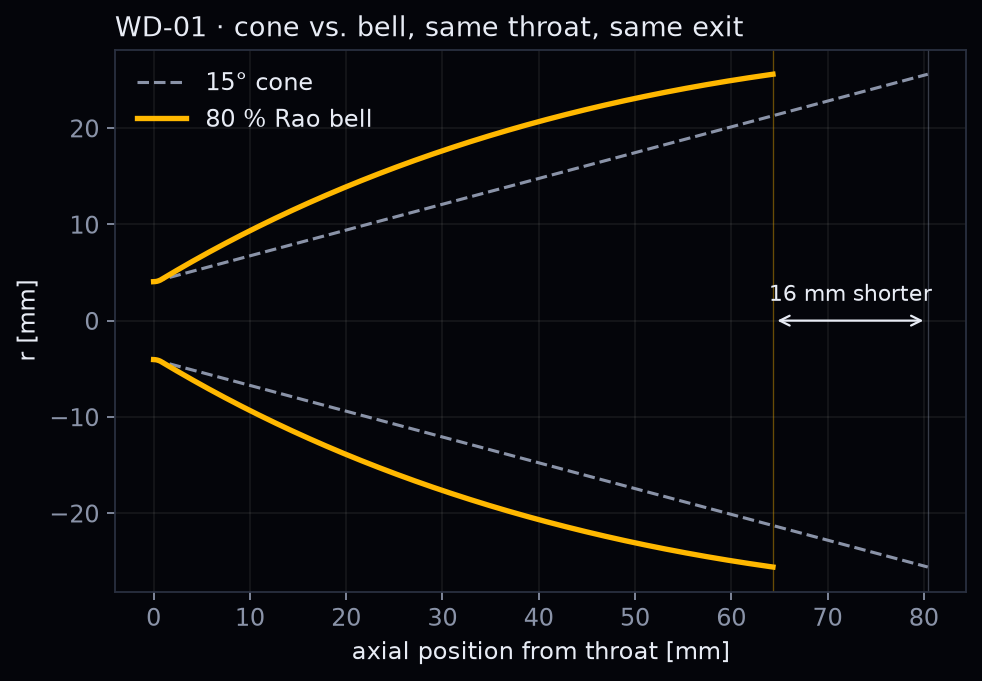
A Rao thrust-optimised bell replaces the cone: 20 % shorter, 6 % less wall to cool and to print, and it wins back about half of the cone’s divergence loss.

Nozzle length
80 → 64 mm
Wall area
−6 %
Vacuum Isp
357 → 360 s
Exit wall angle
8°
Cone and bell nozzle contours compared, bell 16 mm shorter
Same throat, same exit: the bell is 16 mm shorter.

Why a bell

A cone is easy to make, but the gas leaves it like a spherical spray, partly sideways. A bell turns the flow back towards the axis, so more of the momentum pushes the engine forward. That is why nearly every modern rocket engine has one.

How we built it

The classical parabolic approximation of Rao’s optimum contour: a small arc at the throat, then a parabola to the exit, 80 % as long as a 15° cone with the same area ratio. The wall starts at 31° and ends at 8°.

What we found

The bell is 16 mm shorter and has 6 % less wall area, which means less to cool and less to print. Thrust at the same mass flow rises by roughly 0.7 %, about half of what the cone throws away. The exact figure needs the method of characteristics or CFD, which follows in week 4.
From the calculation

day02_wd01_bell_nozzle.ipynbexcerpt, simplified
λ = (1 + cos α) / 2  cone 15° → 0.983
# Rao bell, parabolic approximation (area ratio 40)
th_n, th_e = 31.0, 8.0                   # wall angles from Rao's charts
L_bell = 0.8*(np.sqrt(eps) - 1)*Rt/np.tan(np.radians(15))

# Quadratic Bezier from the throat arc (N) to the exit (E)
B = (1-t)**2*N + 2*(1-t)*t*Q + t**2*E
Length   cone   80.4 mm   bell   64.3 mm   (20 % shorter)
Wall area cone   77.5 cm²  bell   72.5 cm²  (6 % less)
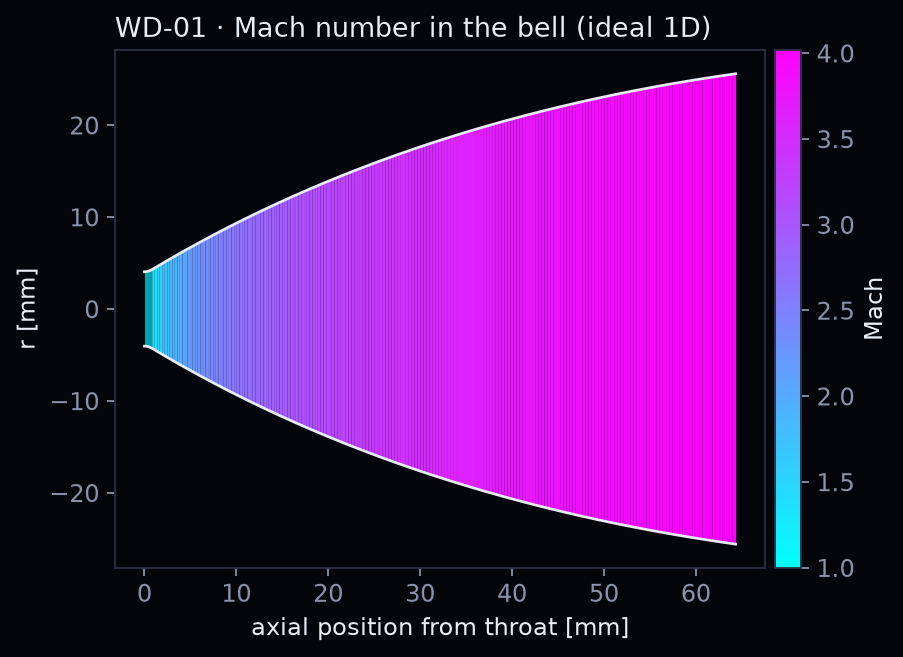
Bell nozzle coloured by Mach number from 1 to 4
Mach number along the bell, from the throat to Mach 4 at the exit.

Simulation, not test results · Published 2026-10-21