Warp Dynamics / Engineer's log / Run 01
Engineer's log, stardate 2026.10.21Run 01

WD-01 physics baseline

Chamber chemistry, vacuum performance and main dimensions of WD-01, the 100 N methane/oxygen thruster. The reference every later AI result is measured against.

Chamber temperature
3,250 K
Vacuum Isp (ideal)
363 s
Mass flow
28 g/s
Throat / exit
8.1 / 51 mm
Exit Mach number
4.0
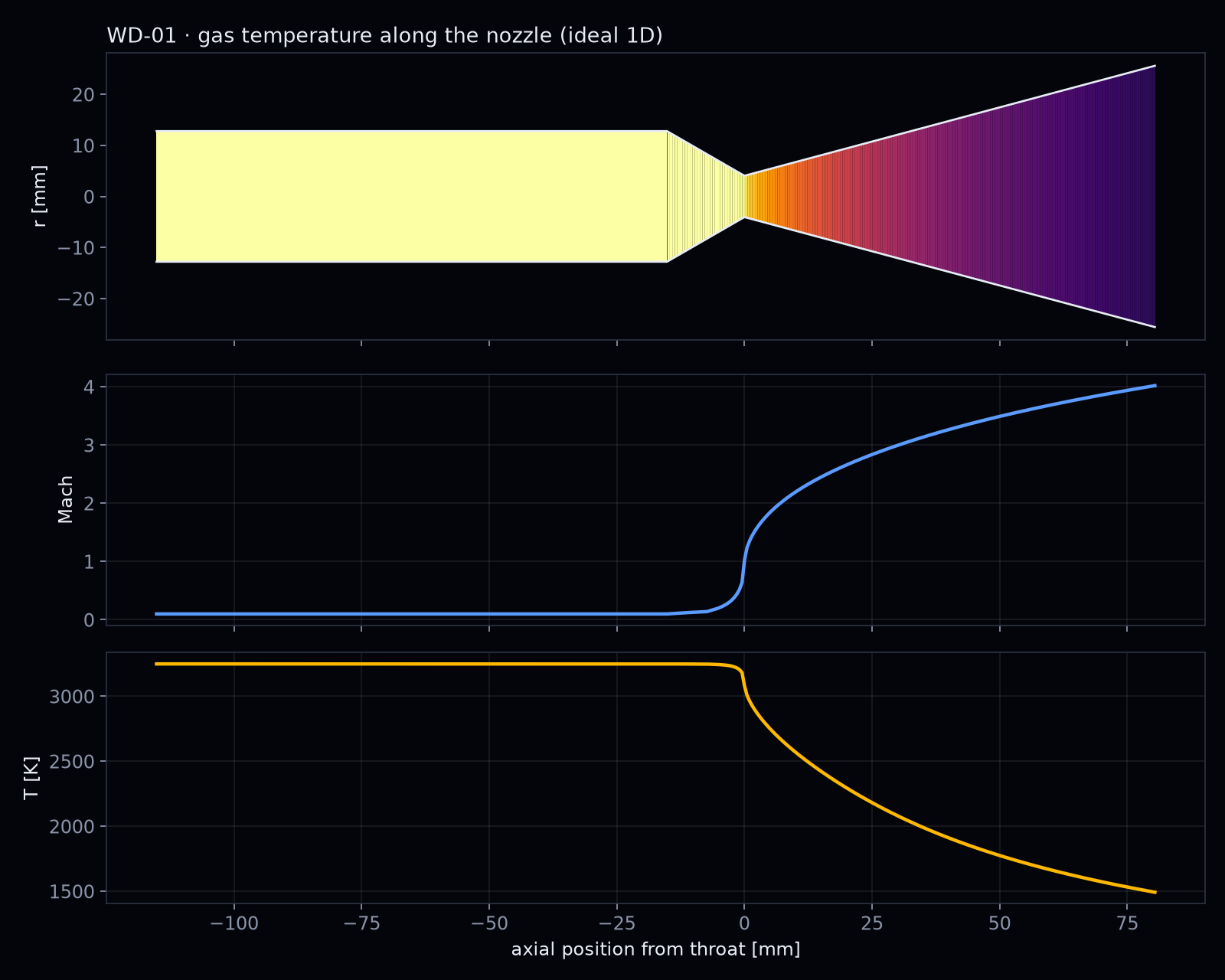
WD-01 nozzle coloured by gas temperature, with Mach number and temperature along the axis
Gas temperature, Mach number and temperature along a simple conical nozzle.

What we set out to do

Before any AI touches WD-01, it needs a physics baseline: the numbers a classical calculation gives, so that every later design can be compared against them. This is level 1 of our test ladder.

Requirements

100 N of thrust in vacuum, liquid methane and liquid oxygen, 10 bar chamber pressure, nozzle area ratio 40. A small pressure-fed engine for satellites and in-space stages.

How we computed it

Chemical equilibrium in the chamber at constant enthalpy and pressure, then an isentropic expansion with shifting equilibrium through the nozzle, using NASA thermodynamic data. A sweep over the mixture ratio from 2.2 to 4.0.

What we found

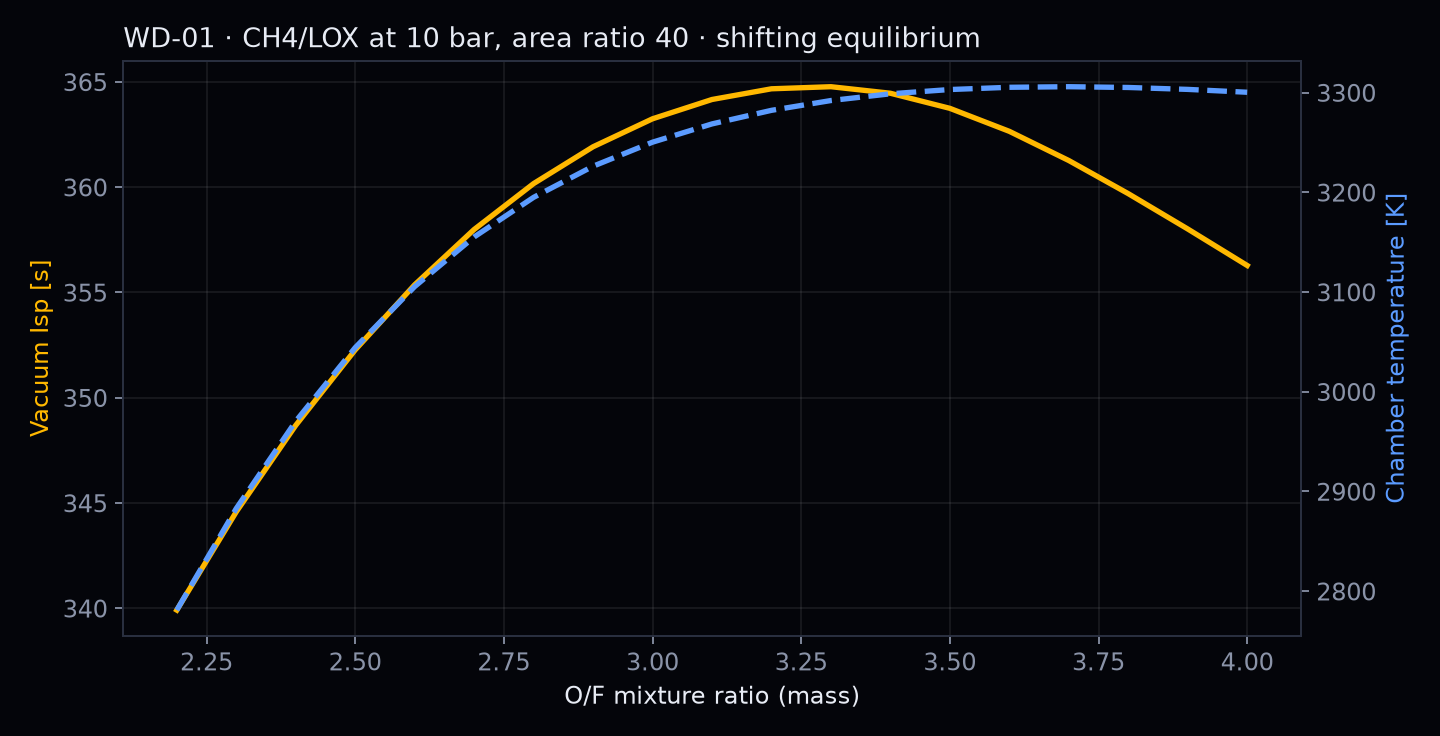
Peak vacuum Isp is 364.8 s at a mixture ratio of 3.3. We chose 3.0: almost the same performance, a cooler chamber and less free oxygen near a copper wall. That gives 363 s, a mass flow of 28 g/s, an 8.1 mm throat and a 51 mm exit. A simple 15° cone loses 1.7 % of the thrust through sideways flow.
From the calculation

day01_wd01_baseline.ipynbexcerpt, simplified
ve = √(2 (hc − he))  Isp = (ve + pe Ae / ṁ) / g0
# Adiabatic flame: chemical equilibrium at constant enthalpy and pressure
gas.HP = h_liquids, 10e5
gas.equilibrate('HP')

# Nozzle: isentropic expansion with shifting equilibrium
gas.SP = s_chamber, p
gas.equilibrate('SP')
v = np.sqrt(2*(h_chamber - gas.h))      # exhaust velocity
Chamber temperature             3250 K
Vacuum Isp (ideal)              363.2 s
Mass flow                       28.07 g/s
Throat diameter                 8.09 mm
Vacuum specific impulse and chamber temperature versus mixture ratio
Vacuum Isp and chamber temperature over the mixture ratio.

Simulation, not test results · Published 2026-10-21