What we tried
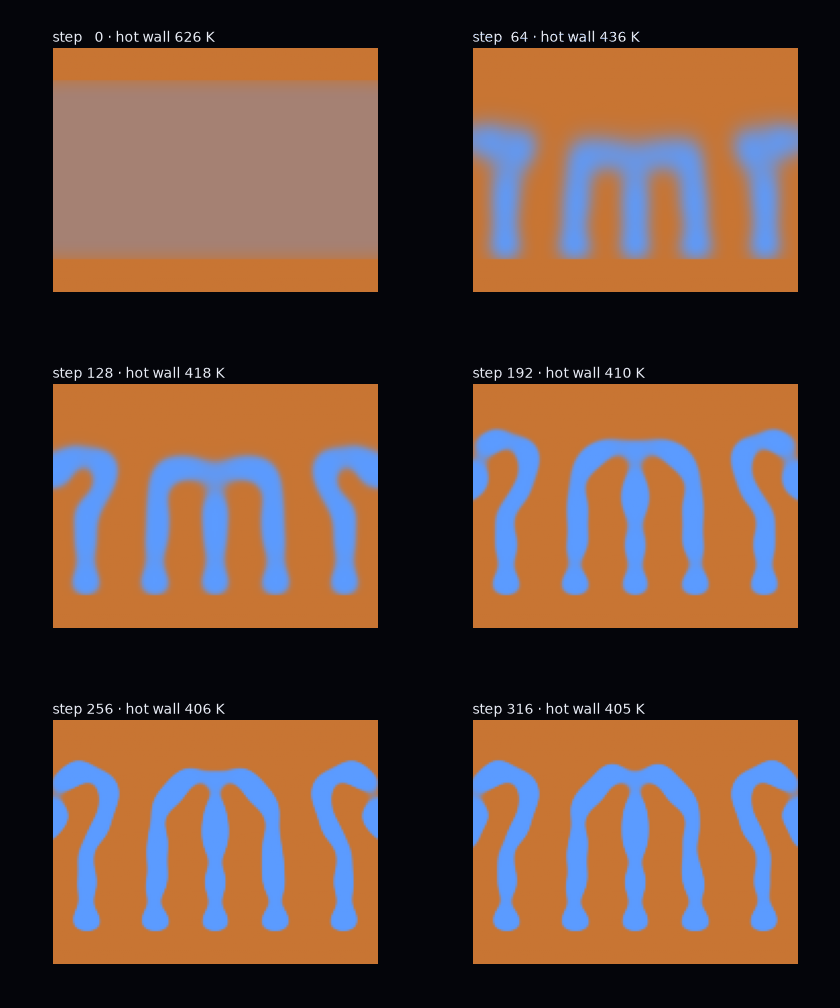
Instead of drawing cooling channels, we let the computer decide for every tiny element of the wall at the throat whether it should be copper or coolant. The goal: keep the wall facing the hot gas as cool as possible, with the same channel area as a classic design. The heat load comes from runs D03 and D04.
What grew
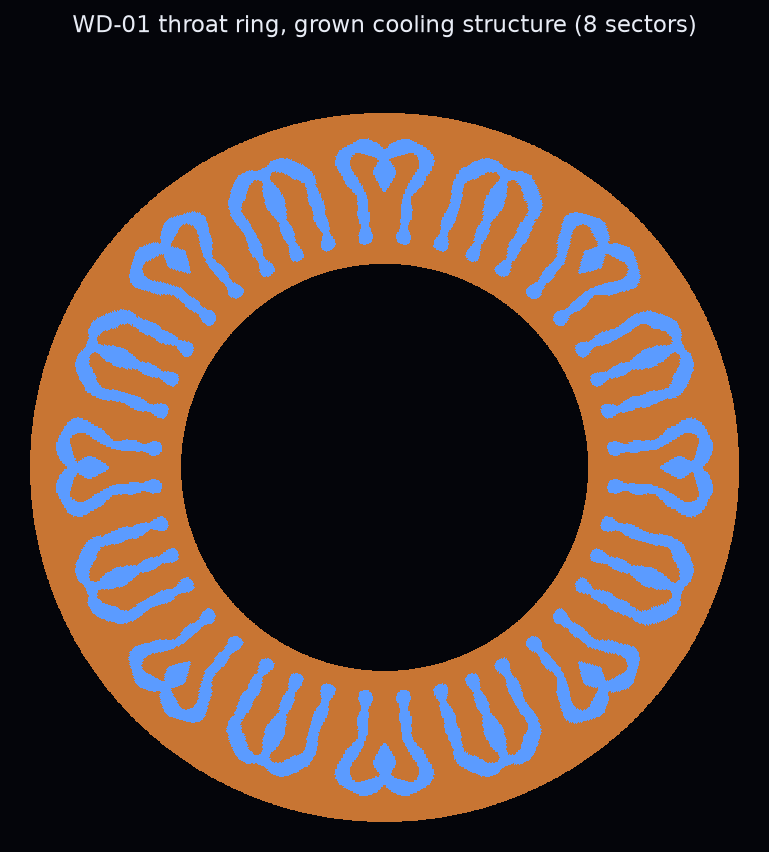
From a uniform start, fingers of coolant reach towards the hot wall, thicken at their tips and join into arches further out. Assembled into the full throat ring, the result looks like a flower.
The honest comparison
Our first run looked spectacular: more than 140 K cooler than a single rectangular channel. But that was the wrong opponent, and its channels were too fine to print. Against the best of 33 classic layouts with the same channel area (here six narrow, tall channels) and printable channel sizes, the grown structure is only 9 K cooler: 401 K instead of 410 K.
Why, and what comes next
The model behind this first step treats the coolant as a simple heat sink. It does not yet know how the coolant flows, how much pressure it loses, or how the heat load changes along the engine. Those are exactly the things an organic shape could do better than straight channels. So this step mainly confirms classic practice. Next we add the coolant flow and its pressure loss to the model, and compute it on GPUs in Google Colab.